
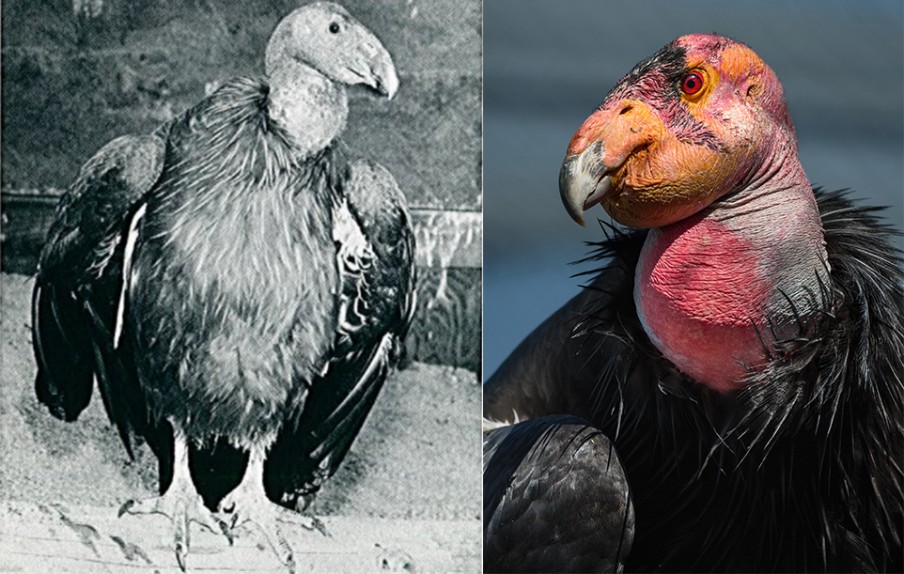
Arriving in 1967, Topa Topa became a founder of the California condor breeding population in human care
to aid in the recovery of the species
To date, his remarkable lineage includes roughly 300 birds,
with 100 currently in the crucial recovery program and 94 flying free in the wild.
PHOTOS & VIDEO GALLERY: CLICK HERE
Credit: © Los Angeles Zoo
LOS ANGELES, CA – April 21, 2026 – This month, the Los Angeles Zoo is commemorating a milestone and recognizing a conservation icon: the 60th year of Topa Topa, the first California condor (Gymnogyps californianus) to reside in a zoo and a founding member of the U.S. Fish & Wildlife Service’s (USFWS) California Condor Recovery Program.
“Topa Topa’s longevity at the Los Angeles Zoo is a testament to the high level of care and wellbeing provided by the Zoo’s animal care and health teams,” said Denise Verret, Los Angeles Zoo CEO and Zoo Director. “He represents so much more than a species; he is a symbol of the California condor’s experience from decline to triumph. His origin story, his recovery, and his unmatched contribution to the California Condor Recovery Program makes Topa Topa a hallmark of conservation success.”
Topa Topa’s story began in early 1967, the same year the California condor was classified as endangered by the United States. Fred Sibley, of the newly established USFWS Endangered Species Program, along with John Boreman from the Audubon Society, recovered the approximately one-year-old fledgling weak, malnourished, and weighing a meager 17 pounds in the mountains of Ventura County, California. After 10 days of rehabilitation at the L.A. Zoo, he was returned to the wild. However, no adult condors were observed near his location and field observations quickly revealed the young bird was unable to forage or defend himself. Because young condors typically learn from their parents for their first year of life, USFWS returned him to the L.A. Zoo permanently for his own survival, making Topa Topa the first-ever California condor to live in a zoo setting. At the time, Topa Topa lived behind the scenes under the close observation of the Zoo’s animal care team.
Seeking to elevate public awareness regarding the species’ decline, the USFWS and partner agencies requested an educational presence for the California condor. In 1978 the L.A. Zoo answered the call, and in an effort to raise awareness of the decline of the species, Topa Topa once again made history as the first California condor to be exhibited to the public. Residing near what is now the jaguar habitat in the Rainforest of the Americas, Topa Topa served as a vital public ambassador while the species continued to decline in the wild. This was a crucial step in public education about the threats faced by the California condor in the wild and the increasingly dire situation and dangerously uncertain future facing the remaining population.
By 1982, the California condor population had reached a critical breaking point prompting an emergency intervention. All remaining condors, both wild and in human care, became participants in the newly established California Condor Recovery Program. The recovery program, led by USFWS, had two founding partners to help create a breeding program for these birds: the Los Angeles Zoo and the San Diego Zoo. Topa Topa transitioned from his public-facing role to a behind-the-scenes program at the L.A. Zoo’s California Condor Recovery Center where he became a vital founding piece of what was a new, monumental movement: helping bring one of California’s most iconic species back from the brink of extinction.
Topa Topa sired his first two chicks in early 1993, both candidates for release to the wild. This milestone marked the beginning of Topa Topa’s legacy.
“The Zoo’s animal care team worked very hard in those early days to understand the birds’ behaviors. It wasn’t an easy road,” said Dominick Dorsa II, Director of Animal Care, L.A. Zoo. “It was a massive challenge and an incredible responsibility, and those early keepers excelled. They worked to create a hospitable environment for the birds to breed and live comfortably with little to no human interaction – keeping them as wild as possible. It took many years to prepare Topa Topa to become a breeding bird in this recovery program, but the outcome was far more exciting than initially expected as he would soon become the program’s biggest asset.”
Today, Topa Topa’s lineage is a testament to the program’s success. He has contributed to the production of roughly 300 birds over his lifetime, with 100 participating in the present-day recovery program as mentors or breeding condors, and 94 still flying free in the wild today.
“When I think of the California Condor Recovery Program, Topa Topa is one of the first things that comes to mind,” said Rose Legato, Curator of Birds, L.A. Zoo. “The plight of the California condor really began to resonate with the public around the same time Topa Topa was brought to the Zoo in the 1960s. It’s beautiful to see how much he has contributed to the recovery of the species and how far we’ve come. His story is not only a celebration; it is a reminder of the critical work we still need to do to fully save the California condor.”
While the total California condor population has grown to more than 600 birds, severe threats to their survival remain. Free-flying condors continue to face population declines due to lead poisoning from consuming carrion hunted with lead ammunition, and new threats loom, such as the highly pathogenic avian influenza (HPAI). The L.A. Zoo remains at the forefront of innovation and recovery, recently serving as a partner facility and leader in a historic HPAI vaccine trial intended to protect the species from the deadly virus.
The California condor is the largest land bird in North America, with wings spanning an amazing nine-and-a-half feet. The species is classified as Critically Endangered by the International Union for Conservation of Nature (IUCN). Adult condors stand at around three feet and weigh 17 to 25 pounds. They can soar to heights of 15,000 feet and travel up to 150 miles a day. Like vultures and other scavengers, condors are part of nature’s cleaning crew, feeding on the carcasses of large terrestrial mammals, including deer and cattle, as well as marine mammals such as whales and seals.
As for Topa Topa, the 60-year-old icon remains behind the scenes at the Zoo’s California Condor Recovery Center playing a vital role in producing chicks that will one day soar over the California landscape.
About the Los Angeles Zoo
The Los Angeles Zoo is accredited by the Association of Zoos and Aquariums (AZA) and is dedicated to providing exemplary animal care and wellbeing. As a trusted leader in local and global conservation efforts, the Los Angeles Zoo is saving wildlife and connecting Angelenos to the natural world by delivering diverse learning opportunities and creating unforgettable experiences. The lush 133-acre campus and its passionate and dedicated team welcomes all to be inspired by the Zoo’s vision to create a just and sustainable world where people and wildlife thrive, together. The Zoo is located on Zoo Drive in Griffith Park at the junction of the Ventura (134) and Golden State (5) freeways. Admission is $27 for adults and $22 for children ages 2 to 12. For more information, visit the L.A. Zoo website at www.lazoo.org.
About the California Condor Recovery Program
The California Condor Recovery Program is an international multi-entity effort led by the U.S. Fish and Wildlife Service (USFWS). Partners in condor recovery include numerous stretching across state, federal, non-governmental and tribal partners. The Recovery Program is working to establish robust self-sustaining populations of condors within the species historical range. The program includes several key components including addressing threats to the species in the wild; captive breeding; and release and monitoring. In addition, we are working to increase the public’s knowledge about the species and how you can support recovery of the condor. The species historically ranged from California to Florida and western Canada to northern Mexico but by the mid-20th century, condor populations had dropped dramatically. By 1982, only 22 condors survived in the wild, in an effort to avoid extinction of the species, USFWS and partners began to capture the remaining wild condors. Five years later, all remaining wild condors were in captivity and a captive breeding program to save the species was underway. Today, USFWS, and its public and private partners, have grown the total wild free-flying condor population to almost 400 condors. For more information, visit www.fws.gov or https://www.fws.gov/program/california-condor-recovery
###
CONTACT:
Carl Myers | 323-644-4273
lazoo.press@lacity.org